Agentic Commerce in Beauty: What Every eCom Manager Needs to Know

You've spent the last few years building something real.
A brand people actually want. A TikTok presence that converts. An Instagram community that trusts you. A Shopify store that works.
You know your numbers. You know what drives traffic. You know what kills a sale.
And now everyone is talking about AI like it changes everything — yet nobody is explaining what that actually means for you, sitting at your desk, trying to hit your conversion targets this month.
Why Agentic Commerce Is the Biggest Shift in Beauty Ecommerce Right Now
Shoptalk Europe — 4,500 of the most senior people in global retail, all in one room.
The phrase that defined the whole event wasn't personalisation. It wasn't social commerce. It wasn't even TikTok Shop.
It was agentic commerce.
And the person who said it most clearly was Mark Elkins, Global Head of Ecommerce at L'Oréal — the biggest beauty company on the planet. "In a world where discovery, consideration, purchase and fulfilment can all happen through agents, trust becomes a retailer's last and most durable asset."

What Is Agentic Commerce — And What Does It Mean for Your Beauty Brand?
Let's start with the plain language definition because most people in beauty ecommerce have never heard this term before — and that is exactly why this is your opportunity.
The Simple Definition
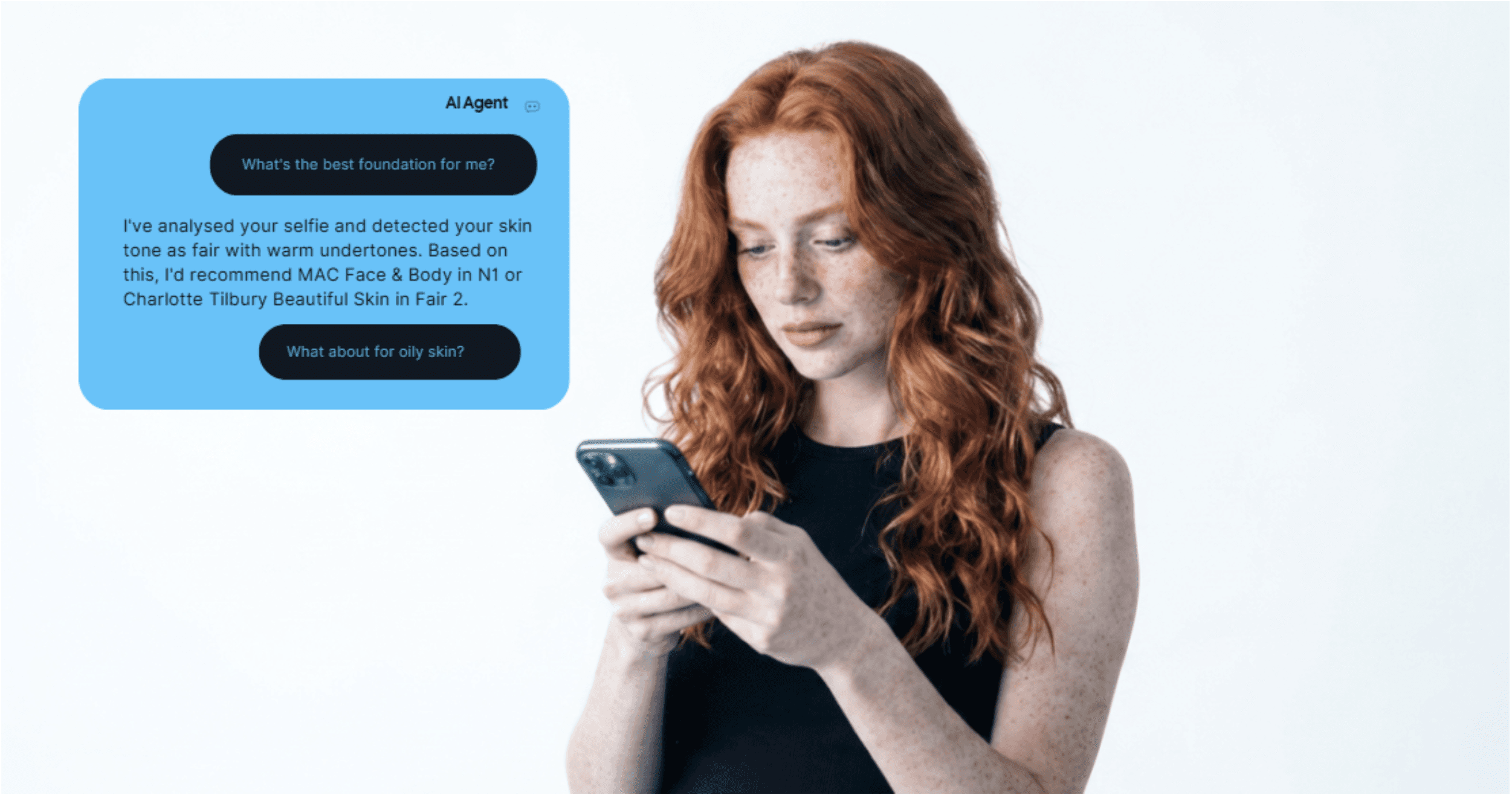
Agentic commerce is when an AI agent — ChatGPT, Perplexity, Google AI Mode — searches, compares, and recommends products on behalf of your customer. Not a chatbot waiting to be clicked. An autonomous system that receives a goal, goes and finds the answer, and comes back with a recommendation.
What It Looks Like in Real Life
Your customer types "find me a clean serum for sensitive skin under €40 that ships to Ireland."
The agent searches. It evaluates. It recommends.
She never opens Google. She never scrolls TikTok. She never lands on your product page.
Your brand either shows up in that answer — or it doesn't.
Beauty has always been sold through human trust. Even the Ancient Romans employed cosmetae — personal beauty advisors whose sole job was to know your skin, recommend what worked, and apply it with their own hands. Our modern word "cosmetic" comes directly from them. From the department store beauty counter to the magazine editor to the TikTok creator showing the texture on her actual skin, the channel has changed every generation. The mechanism never has. Someone you trust tells you this works. You buy it.
Agentic commerce is the first time in history that recommendation comes from a machine. But here's what that actually means for you, AI doesn't replace the human trust signal, or UGC. It amplifies it. The brands that show up inside AIs with the strongest, clearest, most human content will win more customers than they ever could through search or social alone.
The beauty industry is not going anywhere. If anything, it has never had a bigger opportunity. AI commerce is not a threat to the next Glossier or the next Charlotte Tilbury. It is exactly how they get built.
The question is simply whether your brand is ready to be found there.
Your Customers Are Already Using AI to Shop
This is not a future scenario. Agent-driven traffic across the open web has already grown 1,300% in the past nine months. Source: GR4VY, May 2026 —
As recently as last year,Bain & Company reported that 30% to 45% of US consumers are already using generative AI for product research and comparison. And that number is growing.

The Beauty Brands Leading the Way in Agentic Commerce
Charlotte Tilbury
Charlotte Tilbury is the most recommended beauty brand by AI — confirmed as the number one makeup brand by AI citation share globally, and the most recommended beauty brand by AI at Christmas 2025. Its Head of Digital attributes this directly to years of investment in content structured for both humans and AI to find, trust and recommend.and the data proves it. Puig's makeup sales — driven by Charlotte Tilbury — grew over 10% in 2025, well above the industry average, with Q4 described as a "standout" quarter.
Glow Recipe
Glow Recipe holds a 12% AI citation share — placing it joint eleventh in the AI Beauty Authority Index 2026 alongside Paula's Choice and Chanel — ahead of brands with far larger marketing budgets. Its Korean skincare positioning means it surfaces consistently in "best skincare for [skin concern]" prompts across every major AI shopping interface.
Is Your Shopify Beauty Store Visible to AI Shopping Agents?
Here's something most beauty brand operators don't know yet.
In March 2026, Shopify quietly activated agentic storefronts by default for all eligible merchants. That means if you have a Shopify store and your product data meets basic standards — your products are already being surfaced inside ChatGPT conversations.
You didn't opt in. It happened automatically.
Since January 2025, AI-driven traffic to Shopify stores has grown eight times year over year, while orders from AI-powered searches have increased fifteen times.
The question isn't whether your brand is in this system. It probably already is. The question is whether what the AI says about your products is accurate, compelling, and complete enough to close the sale — or whether a competitor with better product data is getting chosen instead.
That's the opportunity. And it's yours to take right now.
Why AI Commerce Hits Differently for Beauty Brands
Here's the thing about beauty that makes this more urgent for you than for, say, a brand selling phone cases.
Beauty is a confidence purchase.
Your customer doesn't just want to know if the product exists. She wants to know if it works for her — her skin type, her tone, her routine, her budget. That confidence has always been built through a real human voice. The founder on camera. The creator showing the texture on her actual skin. The girl in the comments saying "I have the same undertone and this is perfect."